


For most buyers, selecting the right galvanized (GI) square and rectangular tube specifications is essentially a decision-making process that balances application requirements, structural strength, and total cost. Different industries show clear and repeatable patterns in size selection, driven by load conditions, fabrication needs, and budget constraints.
Understanding these patterns helps procurement managers, engineers, and distributors avoid over-design, reduce unnecessary cost, and ensure reliable performance.
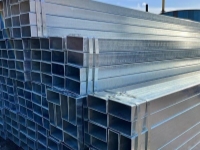
Galvanized Square and Rectangular Tubes for Building Decoration Applications
In building decoration and light architectural applications, customers typically prioritize appearance, ease of installation, and cost efficiency rather than high load-bearing capacity.
Commonly selected specifications include 20×20×1.2 mm, 30×30×1.5 mm, 40×40×1.8 mm, and 50×50×2.0 mm. These smaller-size galvanized square tubes and rectangular tubes are widely used for door and window frames, railings, handrails, partitions, and decorative structures.
Wall thickness in this sector usually ranges from 1.2 mm to 2.5 mm, providing sufficient rigidity for daily use while keeping material costs under control. The zinc coating also ensures corrosion resistance in indoor and semi-outdoor environments.
GI Square and Rectangular Tube Specifications for Machinery and Warehousing
For general machinery, storage systems, and warehousing, buyers seek a practical balance between structural strength, processing convenience, and cost.
Popular choices include 50×50×2.5 mm, 80×80×3.0 mm, 100×50×3.0 mm, and 120×60×3.0 mm. These galvanized rectangular tube specifications are commonly used for light equipment frames, workbenches, conveyor supports, and medium-duty shelving systems.
Among them, the 100×50 mm rectangular tube is especially favored due to its excellent bending strength-to-weight ratio, making it more economical than square tubes in beam-type structures. This size range represents the most widely circulated and readily available products in the market.
Heavy-Duty Galvanized Square and Rectangular Tubes for Industrial Structures
In industrial and heavy structural applications, load-bearing capacity and safety margins become the dominant factors in specification selection.
Buyers in this sector often choose larger and thicker profiles such as 100×100×4.0 mm, 150×100×5.0 mm, 200×200×6.0 mm, and 300×200×8.0 mm. These galvanized square and rectangular tubes are used for factory platforms, equipment foundations, and main structural frames.
Unlike light-duty applications, these specifications must be confirmed through structural calculations, which usually lead to wall thicknesses of 4.0 mm or greater. Many of these heavy-duty sizes are not standard inventory items and therefore require custom production, resulting in longer lead times and higher unit costs.
Galvanized Rectangular Tubes for Agriculture and Greenhouse Structures
In agricultural facilities and simple greenhouse construction, buyers focus on cost efficiency, corrosion resistance, and adequate strength rather than over-engineered designs.
Frequently selected sizes include 40×20×1.5 mm, 50×30×1.8 mm, and 60×40×2.0 mm, mainly used for greenhouse arches, longitudinal beams, and supporting frames. Rectangular tubes are preferred because they offer better bending resistance when installed with the longer side oriented vertically.
Wall thickness in agricultural applications generally falls between 1.5 mm and 2.2 mm, achieving a lightweight structure while maintaining sufficient durability for seasonal and long-term use.
Key Technical Considerations When Selecting GI Square and Rectangular Tubes
When specifying galvanized square or rectangular tubes, buyers should always use the complete format:
Outer Side Length × Outer Side Width × Wall Thickness. Among these parameters, wall thickness is the most critical factor affecting both load-bearing capacity and price.
From a structural perspective, rectangular tubes are more efficient than square tubes in bending-dominated applications such as beams and frames. Using a rectangular tube with the longer side oriented along the load direction can significantly reduce material weight while maintaining strength.
Market availability is another practical factor. High-demand sizes such as 40×40 mm, 50×50 mm, and 100×50 mm are typically kept in stock with multiple wall thickness options, ensuring fast delivery and transparent pricing. In contrast, oversized or extra-thick specifications often require mill customization.
For critical load-bearing projects, relying solely on industry habits is risky. Buyers should always provide load conditions to a structural engineer or experienced steel supplier for verification before finalizing specifications.
Conclusion
Although galvanized square and rectangular tube specifications may appear highly diverse, market demand clearly shows that selection is driven by application scenario, structural performance, and cost efficiency. The 50×50×2.5 mm to 100×50×3.0 mm range dominates the market because it offers the best balance of strength, availability, and price.
By understanding these selection patterns, buyers can make more accurate procurement decisions, improve project cost control, and align product planning with real-world demand rather than assumptions.
FAQ:
Q1: What is the most common wall thickness for GI square and rectangular tubes?
Typically between 1.2 mm and 3.0 mm, depending on application and load requirements.
Q2: Why are rectangular tubes preferred over square tubes for beams?
Rectangular tubes offer higher bending resistance when the longer side is oriented along the load direction, making them more economical.
Q3: Are all GI square and rectangular tube sizes available in stock?
No, high-traffic sizes like 50×50 mm or 100×50 mm are stocked, while oversized or extra-thick tubes usually require custom production.


