


Under the requirements of the American Petroleum Institute and API 5CT, N80 and P110 are two of the most widely specified casing pipe grades used in oil and gas well construction.
Although both belong to API 5CT, they differ significantly in:
Yield strength
Well depth application
Heat treatment process
Cost structure
Collapse and tensile resistance
Understanding these differences is critical for drilling engineers, procurement teams, and EPC contractors selecting casing pipe for medium, deep, or high-pressure wells.
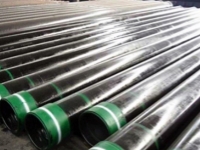
What Is a Casing Pipe?
A casing pipe is a heavy-duty steel tubular product installed in drilled wells to:
Support the wellbore structure
Prevent formation collapse
Isolate subsurface pressure zones
Protect freshwater aquifers from contamination
Maintain long-term well integrity
According to API 5CT, casing and tubing must meet defined requirements for:
Chemical composition
Mechanical properties
Heat treatment
Hydrostatic testing
Thread connections
Inspection standards
Among all API 5CT grades, N80 and P110 casing pipe are the most commonly specified for intermediate and deep wells.
API 5CT Casing Pipe Grades and Mechanical Properties
API 5CT grades are primarily classified by minimum yield strength (the stress level at which permanent deformation begins).
|
Grade |
Minimum Yield Strength (psi) |
Typical Application |
|
J55 / K55 |
~55,000 |
Shallow, low-pressure wells |
|
N80 |
~80,000 |
Medium-depth, moderate-pressure wells |
|
L80 |
~80,000 |
Sour service (H₂S environments) |
|
P110 |
~110,000 |
Deep, high-pressure wells |
|
Q125 |
~125,000 |
Ultra-deep / extreme stress wells |
While L80, C90, and T95 serve specialized environments, N80 and P110 remain the core comparison in standard vs high-performance casing design.
N80 vs P110 Casing Pipe: 5 Key Differences
1. Yield Strength
N80: Minimum 80,000 psi
P110: Minimum 110,000 psi
P110 provides approximately 37% higher yield strength, enabling better resistance to downhole deformation under high stress.
2. Application Depth and Pressure Rating
N80 casing pipe is typically selected for:
Medium-depth wells
Moderate internal pressure
Standard onshore drilling programs
P110 casing pipe is preferred for:
Deep wells
High-pressure / high-temperature (HPHT) conditions
Long casing strings with heavy loads
3. Heat Treatment Process
N80: May be normalized or quenched & tempered (depending on type N80-1 or N80-Q)
P110: Fully quenched and tempered
The quench-and-temper process enhances toughness, strength uniformity, and load-bearing capability.
4. Cost Comparison
N80 → More economical and widely available
P110 → Higher manufacturing cost due to stricter mechanical control and performance requirements
From a procurement standpoint, N80 often offers the best balance between cost and performance for standard drilling programs.
5. Collapse Resistance and Tensile Capacity
P110 casing pipe provides:
Higher collapse resistanc
Greater tensile load capacity
Improved performance under high axial loads
This makes P110 more suitable for:
Extended reach wells
Deep offshore wells
High-stress drilling environments
When to Choose N80 vs P110 Casing Pipe?
Choose N80 if:
The well is medium depth
Pressure levels are moderate
Budget efficiency is a priority
Standard mechanical performance is sufficient
Choose P110 if:
The well is deep or HPHT
Higher collapse resistance is required
Long casing strings increase axial load
Safety margin is critical
FAQ:
1. Is P110 always better than N80?
Not necessarily. While P110 has higher strength, it also costs more. For many medium-depth wells, N80 provides sufficient performance at lower cost.
2. Can N80 be used in deep wells?
It can, but engineering evaluation of collapse pressure and tensile loads is required. In high-stress environments, P110 is typically safer.
3. Is P110 suitable for sour service (H₂S)?
Standard P110 is not automatically suitable for sour service. Additional requirements and compliance with NACE standards may apply.
Conclusion
The comparison between N80 and P110 casing pipe under API 5CT is fundamental in drilling engineering.
N80 → Reliable, cost-effective, medium-depth solution
P110 → High-strength, deep-well, high-pressure solution
Selecting the correct casing pipe grade based on mechanical properties, well depth, and environmental conditions ensures:
Wellbore integrity
Operational safety
Long-term structural reliability
Cost optimization


