


Steel pipe fittings must be permanently and clearly marked using methods such as stamping, engraving, or labeling. Markings should be placed in visible, low-stress areas on the fitting and include key information such as manufacturer, material grade, size, wall thickness, traceability number, and applicable standards.
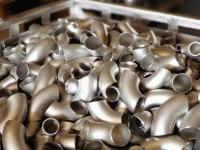
Marking ensures:
Traceability of materials and production batches
Compliance with international standards
Correct installation and identification on-site
Key Insight: Improper marking can lead to misidentification, installation errors, or compliance rejection.
Steel pipe fittings should use durable and permanent marking methods, including:
Stamping
Engraving
Etching
Tagging or labeling (when direct marking is not feasible)
Important Note:
When stamping is applied:
Avoid excessive depth or sharp impressions
Prevent reduction of wall thickness below allowable limits
Minimize risk of stress concentration or cracking
Markings should be applied:
Directly on the fitting surface (when size permits)
In clearly visible and accessible areas
Key Requirements:
Avoid high-stress zones (e.g., weld seams, bending areas)
Ensure markings remain legible after installation and coating
Steel pipe fittings should include the following information:
Manufacturer name or trademark
Material grade
Nominal size (DN) or specified outer diameter
Wall thickness or schedule (e.g., Sch40, Sch80)
Product serial number or heat number (traceability)
Product code or type (e.g., elbow, tee, reducer)
Applicable standard number (e.g., GB/T, ASME, etc.)
Additional contract-specific requirements
Core Principle: Markings must ensure full identification from production to installation.
When the fitting size is too small to accommodate full marking:
Information may be reduced in priority order
Alternatively, use labels or tags attached to the product
This ensures traceability without compromising product integrity.
Example 1: Seamless Elbow
Format:
Manufacturer + Material Grade + DN + Schedule + Traceability + Standard
Sample:
Brand / AF12-DN100-Sch40 / Heat No. / GB/T12459
Example 2: Welded Tee
Format:
Material + Main Pipe Size + Branch Size + Traceability + Standard
Sample:
Brand / CF415k-Φ820×14-Φ630×12 / Heat No. / GB/T12459-B
Example 3: Concentric Reducer
Format:
Material + DN Size + Series + Schedule + Traceability
Sample:
Brand / CF48k-DN150×100-II-Sch80 / Heat No. / GB/T12459
Example 4: Stainless Steel Elbow (Special Requirements)
Includes additional testing or treatment info
Sample:
Brand / S304/S304L-DN300-Sch120 / Heat No. / GB/T12459 + GB/T13401
Q1: What is the most common marking method?
Stamping is the most common, but must be controlled to avoid material damage.
Q2: Can markings be placed anywhere on the fitting?
No, they must avoid high-stress areas and remain visible after installation.
Q3: What if the fitting is too small?
Use abbreviated markings or external labels to maintain traceability.
Q4: Why is the heat number important?
It ensures full traceability of the raw material and production batch.
Marking of steel pipe fittings is a critical requirement for traceability, compliance, and safe installation. By using appropriate marking methods, selecting proper locations, and ensuring complete identification information, manufacturers can guarantee that fittings meet both engineering standards and project requirements while minimizing operational risks.


