


Drill pipes are core load-bearing components in oil & gas drilling, HDD (horizontal directional drilling), and geological exploration. They transmit torque, axial tension, bending stress, and impact load.
Material selection directly determines:
Yield strength
Fatigue life
Wear resistance
Corrosion resistance
Lifecycle operating cost
In industrial practice, high-strength alloy steel remains the dominant material, while alternative materials are used for specialized environments.
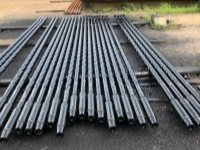
Common Drill Pipe Materials
Alloy Steel (Mainstream Material)
Alloy steel drill pipes offer high tensile strength, torsional resistance, and fatigue durability. They are suitable for:
High-pressure wells
Deep wells
High-temperature formations
High torque operations
Common Grades under API Spec 5DP
|
Steel Grade |
Minimum Yield Strength (ksi) |
|
E75 |
75 |
|
X95 |
95 |
|
G105 |
105 |
|
S135 |
135 |
Industry Fact:
API high-strength alloy steel drill pipe accounts for over 90% of oil & gas drill strings due to its optimal balance of strength, fatigue resistance, and cost.
Carbon Steel Drill Pipe
Carbon steel drill pipe provides adequate rigidity and strength but has weaker corrosion resistance.
Best suited for:
Shallow wells
Low-pressure formations
Cost-sensitive projects
It is economical but unsuitable for deep, corrosive, or high-torque environments.
Aluminum Alloy Drill Pipe
Aluminum drill pipe density is approximately 1/3 of steel, offering:
Reduced hook load
Extended horizontal reach
Lower torque demand
Reduced rig energy consumption
However:
Lower wear resistance
Higher cost
Tool joints must remain steel
Common in:
Ultra-deep wells
Long horizontal sections
Weight-reduction drill strings
Stainless Steel Drill Pipe
Stainless steel provides:
Excellent corrosion resistance
High-temperature stability
Improved dimensional stability
Used in:
Acidic formations
High groundwater salinity
Special corrosive environments
Due to high manufacturing cost, it is reserved for niche applications.
Emerging Materials
New materials include:
Titanium alloy drill pipe
Composite or carbon fiber drill pipe
Ceramic-coated drill pipe
These improve weight reduction or corrosion resistance but significantly increase cost and operational complexity.
Drill Pipe Material Standards
To ensure drilling safety and reliability, global standards regulate material composition, mechanical properties, and manufacturing quality.
Major International Standards
|
Standard |
Scope |
|
API Spec 5DP |
Drill pipe technical requirements |
|
API RP 7G |
Drill string design guidelines |
|
ISO 11961 |
International drill pipe standard |
|
SY/T 5561 |
China petroleum drill pipe |
Key Parameters Controlled by Standards
Chemical Composition – Ensures strength and fatigue resistance
Heat Treatment Process – Improves toughness and durability
Dimensional Tolerance – Controls straightness and wall thickness
Inspection & NDT Methods – UT, magnetic particle testing, mechanical testing
Compliance ensures safety, fatigue life, and operational reliability.
How to Choose the Right Drill Pipe Material
Material selection should follow a structured engineering evaluation.
- Working Environment
Hard soil / rock formations → High-strength alloy steel
High humidity / corrosive soil → Stainless steel or coated pipe
High altitude / long reach HDD → Lightweight (aluminum or composite)
- Geological Conditions
Hard rock → Alloy steel (G105 / S135)
High groundwater level → Corrosion-resistant materials
Deep wells → Higher steel grade required
Fault zones / fissures → High toughness materials
- Mechanical Property Requirements
High torque → Higher yield strength
Frequent bending → Better toughness & fatigue resistance
Abrasive environment → High wear resistance
Review certified mechanical test reports before procurement.
- Corrosion Resistance
Evaluate:
Soil pH
Chloride concentration
Groundwater chemistry
Select material grade or protective coating accordingly.
- Cost-Performance Optimization
Balance:
Initial purchase cost
Expected fatigue life
Maintenance frequency
Replacement interval
The optimal solution is not the strongest pipe — it is the pipe with the lowest lifecycle cost under specific working conditions.
FAQ
Is higher drill pipe strength always better?
No. Excessive strength without proper matching to well depth and torque can increase brittleness risk and unnecessary cost.
Is S135 always better than G105?
Not necessarily.
G105 → Cost-effective for shallow to medium-depth wells
S135 → Suitable for deep wells and high torque operations
Material grade should match engineering load requirements.
What is the most commonly used drill pipe material?
High-strength alloy steel under API Spec 5DP (E75–S135) is the most widely used material in oil, gas, and HDD drilling due to its balanced strength, fatigue resistance, and cost efficiency.
Summary
Modern drill pipe materials are dominated by API high-strength alloy steel grades (E75–S135), which occupy the majority of oil & gas and trenchless drilling markets.
Alternative materials such as stainless steel, aluminum alloy, titanium alloy, or composite pipes are used only under specialized operating conditions where corrosion resistance or weight reduction justifies higher cost.
Correct material selection is an engineering decision — not a marketing decision.


