


Drill pipe welding is strictly limited and highly regulated.
Although drill pipes can be welded, welding is only permitted for specific steel grades, specific locations, and under strictly controlled process conditions. Conventional API drill pipes must not be arbitrarily welded on-site as load-bearing connections, as this can severely compromise structural integrity and lead to serious downhole safety accidents.
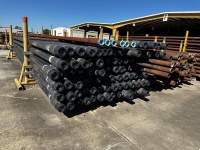
When Is Drill Pipe Welding Allowed?
In practice, drill pipe welding typically refers to the following non-load-bearing or factory-controlled applications:
Repair welding of non-load-bearing areas
Welding of pup joints or auxiliary components
Friction welding (inertia welding) connecting the drill pipe body to the tool joint
According to API Spec 5DP, the connection between the drill pipe body and the tool joint is achieved by friction welding, not manual arc welding. Weld quality directly affects drilling efficiency, fatigue life, and operational safety.
Basic Principles of Drill Pipe Welding
Field welding must never replace the original load-bearing connection
Welding procedures must match the drill pipe steel grade
Welding parameters must be documented and traceable
All welds require inspection before service
Key Processes in Drill Pipe Welding
1. Drill Pipe Preheating
Preheating is essential to reduce:
Thermal stress
Weld cracking
Structural deformation
Typical preheating temperature:
100–250°C, depending on steel grade and wall thickness.
2. Welding Parameter Control
Critical parameters include:
Welding current
Arc voltage
Wire feed speed
Shielding gas flow rate
All parameters must be adjusted based on:
Base material chemistry
Wall thickness
Applicable welding procedure specification (WPS)
3. Post-Weld Treatment
Post-welding operations include:
Weld bead smoothing and grinding
Slag removal
Weld inspection using UT / MT
These steps ensure weld integrity before the pipe is returned to service.
Drill Pipe Welding Equipment and Tools
Welding Equipment
DC welding machines
Automatic or semi-automatic welding systems
Friction welding machines (factory use only)
Auxiliary Tools
Preheating devices (induction or flame)
Temperature monitoring tools (infrared or thermocouples)
Grinding tools and NDT equipment (UT / MT)
Common Welding Electrodes for Drill Pipe
E5015 Welding Rod
Alkaline type
High current density
Good toughness and heat resistance
Suitable for medium and thick sections
Note: produces more spatter
E5016 Welding Rod
Alkaline type with higher tensile strength than E5015
Suitable for high-strength steel structures
Note: may cause shrinkage stress in thin sections
E5018 Welding Rod
Low-hydrogen alkaline electrode
Excellent crack resistance and weld quality
Must be thoroughly dried to prevent hydrogen-induced defects
E55 Series Welding Rod
Low-hydrogen type for ordinary and low-alloy steels
Low spatter and strong impact resistance
Eye protection required due to intense arc radiation
E6010 Series Welding Rod
Cellulosic type, suitable for field operations
Strong penetration and adaptability
Requires experienced welders
Pre-Welding Precautions
Before welding, the following steps are mandatory:
Thoroughly clean the drill pipe to remove oil, rust, and contaminants
Select welding materials and procedures based on drill pipe steel grade
Record all welding parameters for inspection and traceability
Common Problems in Drill Pipe Welding and Solutions
Incomplete Weld Penetration
Causes: insufficient heat input or material mismatch
Solutions: increase current, optimize electrode selection
Weld Cracks
Causes: excessive welding temperature or residual stress
Solutions: controlled parameters, proper preheating, low-hydrogen procedures
Weld Deformation
Causes: improper heat control or insufficient preheating
Solutions: optimized welding sequence and post-weld treatment
Conclusion
Drill pipe welding is not a routine field operation, but a high-risk, tightly controlled process governed by API standards. Improper welding can significantly reduce fatigue life and lead to catastrophic downhole failures.
Only approved welding methods, qualified materials, controlled procedures, and proper inspection can ensure the safety and reliability of welded drill pipe components.
FAQ
Q: What is the strongest seamless steel pipe connection?
A: Welding provides the highest strength and sealing.
Q: When should threaded connections be used?
A: For small-diameter, low-pressure pipelines.
Q: Why use flange connections?
A: For easy disassembly and maintenance.
Q: What sealing is used for threaded pipes?
A: PTFE tape or thread sealant.
Q: What affects pipe joint sealing performance?
A: Connection type, gasket, surface, and preload.


