Class 3000 and Class 6000 are two standard pressure ratings for forged socket weld fittings defined under ASME B16.11.
The key differences are not only pressure capacity, but also pipe compatibility (schedule), structural thickness, dimensional design, and application severity.
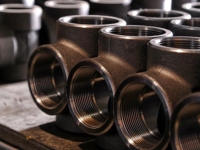
Class 3000: Standard high-pressure rating for general industrial piping
Class 6000: Reinforced high-pressure version designed for more demanding systems
Class 6000 fittings feature significantly thicker walls and are structurally heavier to withstand higher internal pressure.
|
Parameter |
Class 3000 |
Class 6000 |
|
Pressure Rating (A105 carbon steel, ambient) |
~3,000 psi (≈20.7 MPa) |
~6,000 psi (≈41.4 MPa) |
|
Compatible Pipe Schedule |
Sch 80 / XS |
Sch 160 / XXS |
|
Typical Size Range |
1/8" – 4" |
1/8" – 2" |
|
1" Elbow Weight (approx.) |
~0.22 kg |
~0.40 kg |
|
1" Wall Thickness (approx.) |
~4.5 mm |
~7.5 mm |
|
Socket Depth |
Standard |
Deeper (reinforced engagement) |
|
Cost Level |
Baseline |
~1.5–2× higher |
|
Inventory Availability |
Widely stocked |
Limited, longer lead time |
|
Application Level |
Medium–high pressure systems |
High-pressure critical systems |
Because Class 6000 must withstand higher pressure, the fitting body is significantly thicker and heavier than Class 3000.
|
NPS |
Class 3000 Body OD (mm) |
Class 6000 Body OD (mm) |
|
1/2" |
38 |
47 |
|
3/4" |
47 |
53 |
|
1" |
56 |
63 |
|
1-1/4" |
66 |
74 |
|
1-1/2" |
75 |
83 |
|
2" |
90 |
104 |
Key structural insight:
Class 6000 fittings increase body diameter and wall thickness to improve pressure containment and fatigue resistance, but this limits availability to smaller diameters (typically ≤ 2").
Critical Compatibility Requirement
Socket weld systems require strict matching between:
Fitting internal geometry
Pipe outer diameter
Pipe schedule (wall thickness)
Mismatch between Class and pipe schedule leads to:
Flow turbulence at the joint
Local erosion due to velocity disruption
Stress concentration zones
Increased risk of fatigue cracking under cyclic load
Class 3000 — Typical Use Cases
Design pressure ≤ 3,000 psi (≈207 bar)
Petrochemical utility piping systems
Process lines with Sch 80 / XS pipes
General industrial steam, oil, and gas distribution
Systems requiring standard high-pressure reliability
Class 6000 — High-Pressure Use Cases
Design pressure up to 6,000 psi (≈414 bar)
Hydraulic and instrumentation high-pressure lines
Chemical injection and refinery critical lines
Systems requiring Sch 160 / XXS pipe compatibility
Applications requiring higher safety margin and wall reinforcement
Choose Class 3000 when:
Pressure requirement ≤ 3,000 psi
Standard petrochemical piping design
Larger diameter fittings (>2") are needed
Cost optimization is important
Choose Class 6000 when:
Pressure requirement exceeds 3,000 psi
System design requires Sch 160 or higher
Hydraulic or critical sealing applications
Higher fatigue resistance and safety margin are required
Class 6000 is not simply a “higher-rated version” of Class 3000—it is a structurally reinforced design category. Substituting between them without recalculating pipe schedule compatibility can introduce serious mechanical risks at the connection interface.
Proper selection must always consider:
Design pressure
Temperature
Pipe schedule
System fatigue conditions
Q1: What is the main difference between Class 3000 and Class 6000?
Pressure capacity and wall thickness, with Class 6000 roughly doubling the pressure rating.
Q2: Are Class 3000 and Class 6000 interchangeable?
No. They require different pipe schedules and cannot be mixed safely.
Q3: Why is Class 6000 limited to smaller sizes?
Because thicker walls make larger sizes impractical for forging and machining.
Q4: What pipe schedule matches Class 6000 fittings?
Typically Sch 160 or XXS.
Q5: Which industries use Class 6000 fittings most?
Hydraulics, chemical processing, refinery critical lines, and high-pressure instrumentation systems.