Pipe reducer weight calculation is a critical task in piping engineering, affecting material estimation, cost control, lifting design, and stress analysis. The calculation method depends on:
Manufacturing process (rolled plate vs forged)
Geometry (concentric reducer or eccentric reducer)
Applicable dimensional standard (e.g., ASME B16.9)
This guide provides structured formulas, engineering logic, and practical field considerations for accurate reducer weight estimation.
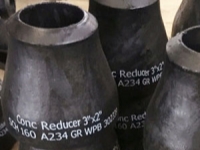
1. Rolled Steel Plate Reducer Weight Calculation (Most Common Method)
Most carbon steel and stainless steel reducers are fabricated by:
Cutting steel plate
Rolling into conical shape
Welding longitudinal seam
Beveling ends
Simplified Engineering Formula
W(kg)=0.384×(D+d)×H×t×ρW (kg) = 0.384 × (D + d) × H × t × ρW(kg)=0.384×(D+d)×H×t×ρ
Variables Definition
|
Symbol |
Meaning |
Unit |
|
W |
Weight |
kg |
|
D |
Large end outer diameter |
mm |
|
d |
Small end outer diameter |
mm |
|
H |
Total reducer height |
mm |
|
t |
Wall thickness |
mm |
|
ρ |
Material density |
kg/mm³ |
Steel Density Reference
Carbon steel: 0.00000785 kg/mm³ (7.85 g/cm³)
SS304: 0.00000798 kg/mm³
SS316: 0.00000800 kg/mm³
This formula approximates the volume of a truncated cone shell and is suitable for cost estimation and logistics planning.
2. ASME B16.9 Reducer Weight Method (Standardized Fittings)
For factory-made butt-welded reducers manufactured according to
ASME B16.9:
What ASME B16.9 Covers
Large end OD
Small end OD
Total length (H)
End bevel geometry
Dimensional tolerances
Marking requirements
Does ASME B16.9 Include Weight Tables?
No.
ASME B16.9 defines geometry only, not theoretical weight.
How Engineers Determine Weight
Determine dimensions from ASME B16.9
Identify wall thickness (SCH 10 / 40 / 80 / 160)
Consult:
Manufacturer catalogs
Engineering databases
3D piping software
3. Forged Reducer Weight Calculation
Forged reducers (typically small diameter, high-pressure service) have thicker walls and more solid mass.
Calculation Principle
Weight=FrustumVolume−InternalHollowVolumeWeight = Frustum Volume - Internal Hollow VolumeWeight=FrustumVolume−InternalHollowVolume
This method requires:
Accurate internal bore measurement
Precise wall profile data
CAD modeling or detailed calculation
Used in:
High-pressure steam systems
Refinery piping
Offshore installations
4. Example: Concentric Reducer Weight Calculation
Given:
Type: Concentric reducer
D = 406 mm
d = 219 mm
H = 356 mm
t = 10 mm
Material: Carbon steel (ρ = 0.00000785 kg/mm³)
Calculation:
W=0.384×(406+219)×356×10×0.00000785W = 0.384 × (406 + 219) × 356 × 10 × 0.00000785W=0.384×(406+219)×356×10×0.00000785 W=6.71kgW = 6.71 kgW=6.71kg
This is a theoretical weight approximation for procurement reference.
Reducer Weight Engineering Characteristics
Reducer geometry produces unique weight behavior patterns.
1. The tapered section consumes approximately 15% more material than a straight pipe of equal length.
2. Large-End Dominance Effect
If the diameter difference exceeds 300 mm:
Total weight approaches ≈85% of large-end material mass
3. Wall Thickness Sensitivity
Weight increases linearly with thickness.
Example reference:
|
Pipe OD |
Weight Increase per +1 mm thickness |
|
530 mm |
≈13 kg/m |
|
219 mm |
≈5.3 kg/m |
Practical Engineering Considerations
a) Surface Treatment Influence
Sandblasting: +2% apparent weight (surface roughness)
Stainless steel reducers require pickling + passivation
Otherwise pitting corrosion may reduce actual mass over time
b) Temperature Effect (High-Temperature Pipelines)
Thermal expansion causes density change.
Rule of thumb:
Every +100°C → theoretical weight decreases ≈0.5%
Important for:
Steam pipelines
Power plant systems
Thermal stress modeling
c) Fabrication Loss
Irregular cutting may produce 10–20% scrap weight
Must be considered in material procurement planning
d) Lifting Planning Reference
|
Reducer OD |
Recommended Lifting Capacity |
|
530 mm |
80–100 kg per piece |
|
219 mm |
35–50 kg per piece |
Always apply safety factor ≥1.5 in rigging calculations.
Conclusion
Accurate pipe reducer weight calculation requires:
Correct dimensional data
Proper material density
Selection of appropriate geometric model
Consideration of fabrication and operational variables
For preliminary estimation, the simplified rolled-plate formula is sufficient.
For critical applications (high pressure, offshore, power plant), detailed modeling or manufacturer-certified weight tables should be used.
FAQ
Q1: What is the fastest way to calculate concentric reducer weight?
Use the simplified formula:
0.384×(D+d)×H×t×ρ0.384 × (D + d) × H × t × ρ0.384×(D+d)×H×t×ρ
Q2: Does ASME B16.9 provide reducer weight tables?
No. ASME B16.9 defines dimensions only. Weight must be obtained from manufacturers or software.
Q3: Is eccentric reducer weight different from concentric?
If dimensions are identical, theoretical shell weight is the same. Geometry difference mainly affects flow, not mass.
Q4: Why is reducer weight important in engineering?
It impacts:
Structural load calculations
Pipe stress analysis
Transportation cost
Crane selection
Project budgeting