Grooved fittings have become a preferred pipe connection solution for modern piping systems because they offer fast installation, reliable sealing, and simplified maintenance. Compared with traditional welded or threaded connections, grooved mechanical systems reduce installation time while providing excellent flexibility for commercial, industrial, and infrastructure projects.
Used together with grooved couplings, these fittings create secure pipe joints that can accommodate vibration, thermal expansion, and system movement. As a result, grooved fittings are widely applied in fire protection, HVAC, water supply, mining, and industrial process piping.
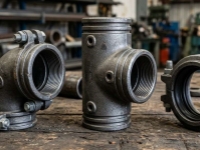
Grooved fittings are mechanical pipe fittings designed with grooved ends that connect to grooved pipes through couplings and gaskets. This connection method eliminates on-site welding, making installation safer and more efficient.
Common types of grooved fittings include:
Grooved elbows
Grooved tees
Grooved reducers
Grooved crosses
Grooved caps
Grooved adapters
Available in multiple materials and sizes, grooved fittings can be selected to match various pressure ratings and piping specifications.
|
Item |
Specification Range |
Description |
|
Material |
Ductile Iron, Carbon Steel, Stainless Steel |
Suitable for different service conditions |
|
Size Range |
1"–24" or customized |
Covers most piping systems |
|
Connection Type |
Grooved Mechanical Connection |
Quick assembly and disassembly |
|
Surface Finish |
Painted, Epoxy Coated, Galvanized |
Enhanced corrosion protection |
|
Working Pressure |
Up to 300 PSI or customized |
Depends on product design |
|
Standards |
ASTM, ANSI, UL, FM |
International manufacturing standards |
Grooved mechanical connections provide several practical advantages over conventional joining methods.
Faster Installation
Grooved systems require fewer tools and eliminate welding operations, significantly reducing installation time and labor costs, especially for large-scale projects.
Improved Jobsite Safety
Since no hot work or open flames are required, grooved fittings help minimize fire hazards and improve workplace safety during construction.
Easy Maintenance
Mechanical couplings can be removed and reassembled quickly, allowing convenient inspection, repair, or future pipeline modifications while reducing system downtime.
Flexible Pipe Movement
Grooved joints accommodate limited thermal expansion, vibration, and minor pipe deflection, helping improve overall system reliability.
Long Service Life
Manufactured with durable materials and protective surface coatings, high-quality grooved fittings deliver dependable performance even in demanding environments.
Grooved fittings are widely used in numerous industries and building systems, including:
Fire protection sprinkler systems
HVAC piping networks
Municipal water supply and drainage
Industrial processing plants
Mining slurry pipelines
Oil and gas facilities
Commercial and residential buildings
Their combination of installation efficiency and dependable sealing makes them particularly popular in large construction and infrastructure projects.
The performance of a grooved piping system depends heavily on the precision and quality of every fitting. Premium grooved fittings are manufactured with accurate dimensions, high-grade materials, and strict quality management to ensure reliable mechanical connections.
Typical quality control procedures include:
Chemical composition analysis
Dimensional inspection
Pressure testing
Surface coating inspection
Connection performance verification
Selecting fittings that comply with international standards helps reduce leakage risks, improve installation efficiency, and extend the service life of the entire piping system.
Q1: What are grooved fittings used for?
Grooved fittings are used to connect pipes in fire protection, HVAC, water supply, industrial processing, mining, and commercial building systems.
Q2: What are the advantages of grooved fittings over welded connections?
They provide faster installation, safer construction without hot work, easier maintenance, and better flexibility for thermal expansion and vibration.
Q3: What materials are grooved fittings available in?
Common materials include ductile iron, carbon steel, and stainless steel, depending on pressure, corrosion resistance, and application requirements.
Q4: How do I choose the right grooved fitting?
Selection should be based on pipe size, working pressure, material compatibility, applicable standards, and the operating environment.