Precision steel pipe tolerance marking defines allowable dimensional and geometric deviations for OD, ID, and shape accuracy. Correct tolerance marking is essential to ensure machining feasibility, assembly compatibility, and cost control.
1. Datum Definition in Precision Steel Pipe Tolerance Marking
A clearly defined tolerance datum is the foundation of all precision steel pipe tolerance specifications. Missing or ambiguous datums are one of the most common causes of supplier–buyer disputes.
Core considerations for datum marking:
Clearly identify datum surfaces or datum axes, prioritizing functional surfaces related to assembly accuracy and load-bearing performance.
Distinguish between independent datums and related (common) datums. When multiple fitting requirements must be met simultaneously, related datums ensure coordinated tolerance control.
Avoid undefined or “arbitrary datum” descriptions, which make manufacturing control and inspection impossible.
Datum marking should comply with GB/T 1182 and GB/T 1800 standards to ensure consistent interpretation.
2. Selecting the Appropriate Tolerance Grade for Precision Steel Pipes
The tolerance grade of precision steel pipes directly impacts manufacturing difficulty, processing cost, and functional reliability.
Key selection rules:
Match tolerance grades to application scenarios.
Mechanical transmission pipes require strict OD and ID tolerances.
Structural or support pipes typically allow H9–H10.
Apply tight tolerances only to critical dimensions, such as bearing seats and flange mating zones, to avoid unnecessary cost escalation.
Always specify the applicable standard and numerical tolerance values, as tolerance grades vary across standards.
Blindly pursuing high tolerance grades often increases cost without improving performance.
3. Relationship Between Dimensional Tolerances and Geometric Tolerances in Precision Steel Pipes
Dimensional tolerances control size variation, while geometric tolerances control shape and positional accuracy. Both jointly determine assembly success.
Key coordination points:
Define required geometric tolerances such as roundness, straightness, cylindricity, and coaxiality based on service requirements.
Understand and correctly apply the envelope principle and the independence principle, especially when assembly clearance is critical.
Evaluate cumulative deviation. Dimensional and geometric tolerances can stack and amplify actual deviation beyond expectations.
Precision steel pipes may meet dimensional tolerance yet still fail assembly if geometric tolerances are ignored.
4. Standardized Tolerance Marking Format for Precision Steel Pipes
Non-standard tolerance marking is a major source of mismatch between specification and delivered products.
Standardization requirements:
Dimensional tolerances must clearly state basic dimensions and tolerance zones or upper/lower deviations.
Geometric tolerances must include tolerance symbols, tolerance values, and datum references.
Avoid vague expressions such as “approximately” or “around.”
Ensure each tolerance corresponds to a single dimension to eliminate ambiguity.
Standardized marking ensures tolerance requirements are unambiguous and globally interpretable.
5. Influence of Manufacturing Process and Material on Precision Steel Pipe Tolerances
Tolerance capability is constrained by processing technology and material characteristics.
Process-based tolerance capability:
Cold-rolled precision steel pipes: typically H7–H8
Cold-drawn precision steel pipes: typically H8–H9
Precision-ground steel pipes: up to H6
Material considerations:
Stainless steel generally requires higher cost to achieve the same tolerance grade as carbon steel due to machinability limits.
Material hardness and stability directly affect tolerance retention.
Tolerance requirements must be confirmed with suppliers to ensure process feasibility.
6. Aligning Precision Steel Pipe Tolerance Marking with Actual Service Conditions
Final tolerance marking must reflect real operating environments, not theoretical precision.
Verification steps:
High-speed rotating precision steel pipes require strict control of cylindricity and coaxiality to prevent vibration.
High-temperature applications must account for thermal expansion and reserve sufficient tolerance clearance.
Each tolerance grade increase may raise processing cost by 30%–50%, requiring cost–performance balance.
For critical applications, conduct small-batch trial production and assembly validation before mass procurement.
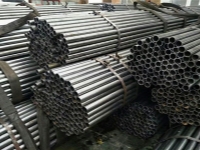
Summary: Best Practices for Precision Steel Pipe Tolerance Marking
Effective precision steel pipe tolerance marking is built on:
Clear datum definition · Appropriate tolerance grade · Coordinated dimensional and geometric tolerances · Standardized marking · Alignment with process capability and service conditions
Avoiding ambiguous datums, excessive or insufficient tolerances, ignored geometric controls, and unrealistic process assumptions ensures tolerance markings are technically valid, manufacturable, and cost-efficient.
FAQ
Q1: What is tolerance marking in precision steel pipes?
Tolerance marking defines allowable dimensional and geometric deviations of precision steel pipes, ensuring machining feasibility, assembly accuracy, and stable functional performance.
Q2: Why is datum definition critical for precision steel pipe tolerance?
A defined tolerance datum ensures consistent measurement and manufacturing control; without it, precision steel pipe tolerances cannot be accurately produced or inspected.
Q3: What tolerance grades are commonly used for precision steel pipes?
Common precision steel pipe tolerance grades include H7–H8 for cold-rolled pipes, H8–H9 for cold-drawn pipes, and H6 for precision-ground pipes.
Q4: What is the difference between dimensional and geometric tolerance in precision steel pipes?
Dimensional tolerance controls size variation, while geometric tolerance controls shape and position accuracy; both are required to ensure proper assembly.
Q5: How do manufacturing processes affect precision steel pipe tolerances?
Manufacturing processes define achievable precision steel pipe tolerances; cold rolling, cold drawing, and precision grinding provide different accuracy and cost levels.
Q6: Why can precision steel pipes fail assembly within dimensional tolerance?
Precision steel pipes may fail assembly when geometric tolerances are uncontrolled, even if dimensional tolerances comply with specification limits.